
The Skill Wheel
Why progress on guitar isn’t linear — and how to keep your playing in motion.

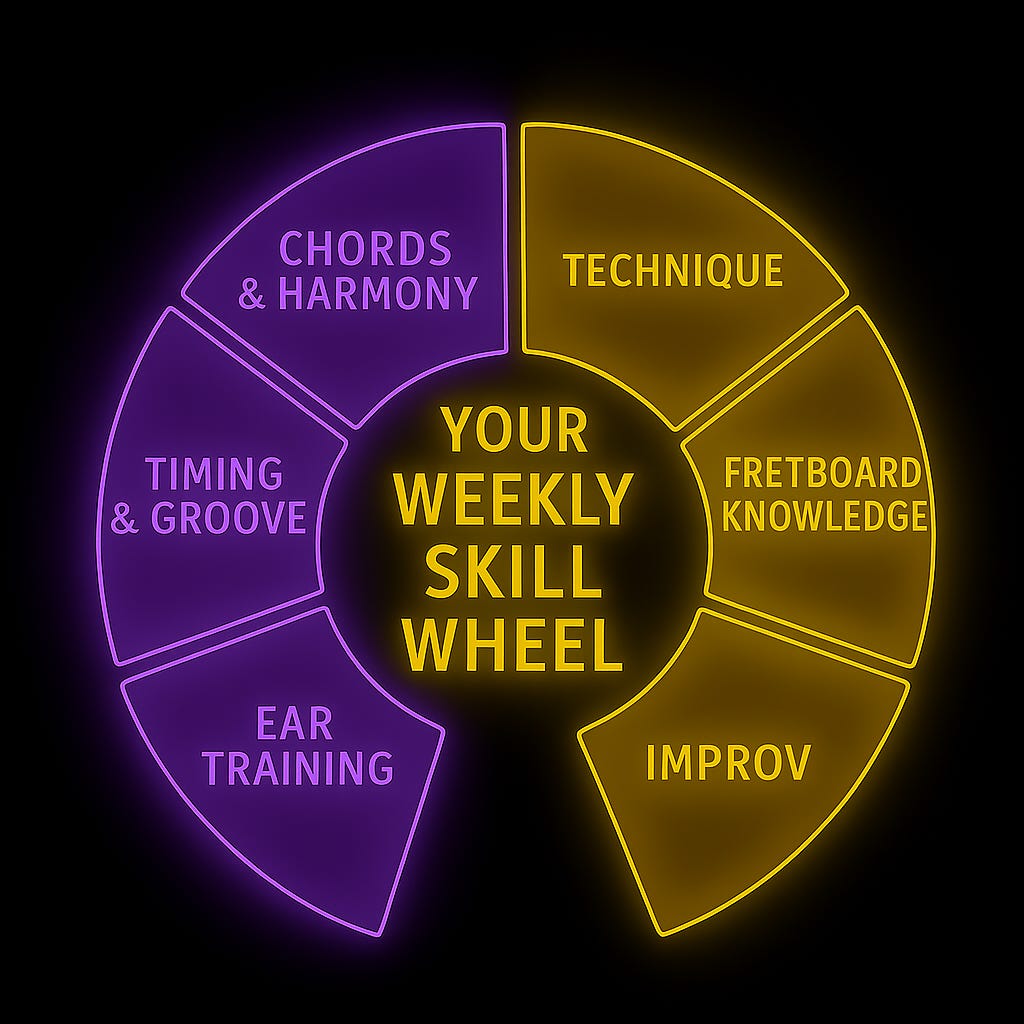
Sometimes you need to see it before it finally clicks.
Learning guitar can feel overwhelming — there are so many things to work on that it’s hard to know where to start. That’s why creating a solid practice routine can be so frustrating.
Every player has a different vision of the guitarist they want to become. That means certain skills will matter more depending on your goals and the style you play. A blues player’s priorities might look totally different from someone diving into funk, metal, or folk.
But here’s the key: skills are connected.
When you strengthen one, you’re often improving another without realizing it. Your rhythm work sharpens your lead phrasing. Your ear training improves your songwriting. Your chord knowledge boosts your improvisation. It’s all part of the same system.
That’s where the Skill Wheel comes in.
Just like athletes don’t train one muscle group, great guitarists don’t focus on a single skill. They rotate through different areas — technique, rhythm, fretboard awareness, tone, creativity, ear, and theory — building balance and control over time.
I created the Skill Wheel to help you visualize your growth — to see the areas you’re strong in, where you’re weak, and what to focus on next. It’s a snapshot of your musical fitness.
The goal isn’t to master everything at once. It’s to build awareness — to train your mind to think like a complete musician, not just a player working through exercises.
When you understand the wheel, you start making smarter decisions with your practice time — and that’s when real progress starts to happen.
Let’s breakdown each skill one by one!
1️⃣ Technique
What it is:
Your physical control — picking accuracy, finger strength, coordination, and tone. Technique isn’t about speed; it’s about efficiency. The smoother you move, the better you sound.
How to practice:
Spend 10–15 minutes on focused mechanics: alternate picking, hammer-ons/pull-offs, string skipping, bending in tune.
Use a metronome. Focus on evenness before speed.
Record short clips to check tension and tone.
2️⃣ Fretboard Knowledge
What it is:
Knowing where everything lives. Scales, arpeggios, intervals, triads — this is your map of the neck. When you understand the fretboard, you stop guessing and start creating.
How to practice:
Map out one key per week: root notes, scale positions, triads.
Play simple melodies or riffs in multiple octaves.
Connect scale shapes diagonally — think movement, not boxes.
3️⃣ Improv
What it is:
Freedom. Improv is how you connect your ear, fretboard, and feel in real time. It’s not about showing off — it’s about expressing something that feels alive.
How to practice:
Jam over one backing track per week.
Restrict yourself: one string, one position, or three notes only.
Record yourself — listen back for phrasing, rhythm, and tone.
4️⃣ Ear Training
What it is:
Developing your internal GPS. The more you recognize sounds — intervals, chord qualities, rhythms — the faster you learn songs and the better you play by feel.
How to practice:
Pick one song per week and find the melody by ear.
Sing intervals (1–3–5, 1–b3–5, etc.) and locate them on the neck.
Use ear-training apps sparingly — focus on translating sound to fretboard.
5️⃣ Timing & Groove
What it is:
The heartbeat of your playing. Good rhythm separates amateurs from pros — it’s how you make people feel something when you play.
How to practice:
Practice with a metronome on beats 2 and 4.
Play muted strumming patterns using 8th or 16th notes.
Learn one riff or groove-based song per week (AC/DC, SRV, Nile Rodgers, etc.).
6️⃣ Chords & Harmony
What it is:
Understanding how chords connect. Harmony is the language of songs — major, minor, dominant, diminished — and how they create movement.
How to practice:
Learn one new chord shape or voicing each week.
Practice connecting chords using common tones or voice leading.
Build small progressions in different styles — pop, funk, blues, jazz.
💡
How to Use the Skill Wheel
Pick 3–4 areas per week to focus on (rotate them monthly).
Write them into your practice plan like a workout schedule.
Track your growth: what’s improving, what needs work.
Keep the wheel balanced — don’t let one slice shrink too small.
🎸 Every skill feeds the next — explore more lessons and practice ideas ↓
#guitarweekly #guitar #lessons #guitarweeklylessons #practice #mindset